
Bodybuilding is not only about building muscle—it is also about showing muscle size, symmetry, proportion, definition, and conditioning. Competitive bodybuilders use specific poses to present their physiques from different angles.
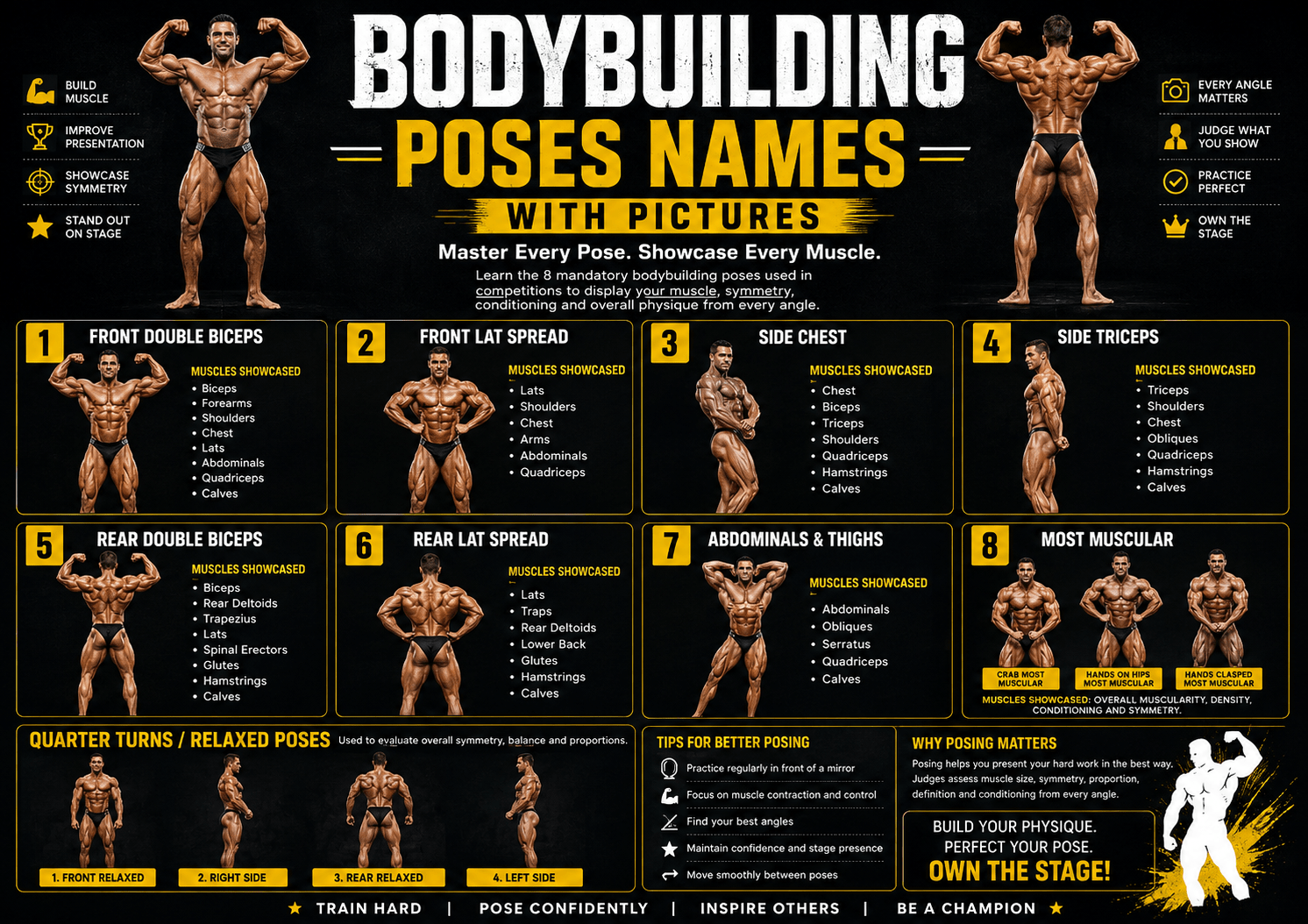
For men’s open bodybuilding, the standard mandatory poses include Front Double Biceps, Front Lat Spread, Side Chest, Rear Double Biceps, Rear Lat Spread, Side Triceps, Abdominals & Thighs, and Most Muscular.
1. Front Double Biceps
Front Double Biceps is one of the most recognizable bodybuilding poses. The athlete faces the judges, raises both arms and flexes the biceps while attempting to display the complete front physique.
Muscles showcased
- Biceps
- Forearms
- Front deltoids
- Chest
- Lats
- Abdominals
- Quadriceps
- Calves
How to perform it
Stand facing forward with your feet positioned comfortably. Raise both arms and bend your elbows, bringing your fists upward. Flex your biceps while simultaneously expanding your lats and tightening your abdomen and legs.
Key point: Don’t focus only on the biceps. A strong Front Double Biceps should present the entire physique.
2. Front Lat Spread
The Front Lat Spread is designed primarily to demonstrate upper-body width and the V-taper.
Muscles showcased
- Latissimus dorsi
- Shoulders
- Chest
- Arms
- Abdominals
- Quadriceps
How to perform it
Place your hands around your waist or hips and position your elbows outward. Expand your rib cage and flare your lats to create as much upper-body width as possible.
The goal is to make the shoulders appear broad while creating a narrow-looking waist.
3. Side Chest
The Side Chest Pose displays the thickness and development of the chest while also showing the arm, shoulder and leg musculature.
Muscles showcased
- Chest
- Biceps
- Triceps
- Shoulders
- Quadriceps
- Hamstrings
- Calves
How to perform it
Turn your body sideways toward the judges. Position the legs to show muscularity and press the chest upward and forward. Bring the arms into position and contract the chest and upper body.
Key point: Proper leg positioning can make a significant difference because the side view also reveals hamstring and calf development.
4. Side Triceps
The Side Triceps Pose emphasizes the triceps while showing the side profile of the torso and legs.
Muscles showcased
- Triceps
- Shoulders
- Chest
- Obliques
- Quadriceps
- Hamstrings
- Calves
How to perform it
Stand sideways and position the arms so the triceps can be fully contracted. Keep the torso tight and position the legs to display separation.
A good side triceps pose should show both arm thickness and overall body conditioning.
5. Rear Double Biceps
The Rear Double Biceps, also called the Back Double Biceps, is one of the most important poses for evaluating the back.
Muscles showcased
- Biceps
- Rear deltoids
- Trapezius
- Latissimus dorsi
- Spinal erectors
- Glutes
- Hamstrings
- Calves
How to perform it
Turn your back toward the judges and raise both arms into a double-biceps position. Flex the arms while spreading the lats and tightening the back and legs.
This pose gives judges a view of the back width, thickness, symmetry and posterior-chain development.
6. Rear Lat Spread
The Rear Lat Spread is the back equivalent of the front lat spread.
Muscles showcased
- Lats
- Traps
- Rear deltoids
- Lower back
- Glutes
- Hamstrings
- Calves
How to perform it
Face away from the judges and place your hands around your waist. Expand the upper back and flare the lats outward.
The objective is to create maximum back width and a strong V-taper.
7. Abdominals and Thighs
The Abdominals and Thighs Pose combines abdominal definition with leg development.
Muscles showcased
- Abdominals
- Obliques
- Serratus
- Quadriceps
- Calves
How to perform it
Face the judges, place your hands behind your head and contract your abdominal muscles. Position one leg forward and tighten the quadriceps to show separation and definition.
This pose is particularly useful for demonstrating core conditioning and thigh development.
8. Most Muscular
The Most Muscular Pose is a powerful pose designed to demonstrate overall muscularity and density. It can be performed in several variations.
Muscles showcased
Almost the entire physique, including:
- Chest
- Shoulders
- Triceps
- Biceps
- Traps
- Abdominals
- Quadriceps
- Calves
Common variations
Crab Most Muscular:
Hands and arms are brought forward while the shoulders and chest are strongly contracted.
Hands-on-Hips Most Muscular:
Hands are placed around the hips while the athlete contracts the upper and lower body.
Hands-Clasped Most Muscular:
The hands are brought together in front of the body to create maximum muscular contraction.
9. Quarter Turns / Relaxed Poses
Before the mandatory muscularity poses, competitors may also be assessed through quarter turns or relaxed positions, depending on the competition format and division. These allow judges to assess overall symmetry and proportions from different angles.
The basic positions include:
- Front relaxed
- Right side
- Rear relaxed
- Left side
These positions help demonstrate overall body balance, symmetry and proportions.
Bodybuilding Poses Cheat Sheet
| Pose | Main Focus |
|---|---|
| Front Double Biceps | Biceps, shoulders, lats, abs, quads |
| Front Lat Spread | Lat width, shoulders, V-taper |
| Side Chest | Chest thickness, arms, legs |
| Side Triceps | Triceps, shoulders, legs |
| Rear Double Biceps | Back, biceps, hamstrings |
| Rear Lat Spread | Back width and V-taper |
| Abdominals & Thighs | Abs, serratus, quads |
| Most Muscular | Overall muscularity and density |
| Quarter Turns | Symmetry and proportions |
Why Are Bodybuilding Poses Important?
A bodybuilder can have excellent muscular development but still lose presentation quality if the physique is not displayed effectively. Posing allows judges to compare competitors from multiple angles and assess muscle size, symmetry, proportions, definition and conditioning.
Regular posing practice can also help athletes learn how to:
- Control individual muscles
- Improve stage presentation
- Find their strongest angles
- Maintain contractions
- Improve transitions between poses
- Display symmetry and proportions
- Become more comfortable under competition lighting
How to Practice Bodybuilding Poses
Start by learning each pose individually rather than trying to memorize the entire sequence at once.
Beginner posing routine
Step 1: Practice in front of a mirror.
Step 2: Learn your foot position.
Step 3: Position your arms correctly.
Step 4: Expand or contract the appropriate muscles.
Step 5: Tighten the entire body.
Step 6: Hold the pose for 10–20 seconds.
Step 7: Practice moving smoothly into the next pose.
As your posing improves, record yourself from the front, side and rear to identify differences in symmetry and presentation.
Bodybuilding Poses vs Physique Poses
Different bodybuilding divisions can have different posing requirements. For example, men’s open bodybuilding has a standard set of eight mandatory poses, while Classic Physique and other divisions can have different requirements and presentation rules.
Therefore, competitors should always check the current rules for their specific federation and division before preparing for a competition.
Frequently Asked Questions
What are the 8 bodybuilding poses?
The commonly recognized eight mandatory men’s open bodybuilding poses are Front Double Biceps, Front Lat Spread, Side Chest, Rear Double Biceps, Rear Lat Spread, Side Triceps, Abdominals & Thighs, and Most Muscular.
Which is the most famous bodybuilding pose?
The Front Double Biceps is probably the most recognizable bodybuilding pose and is widely associated with bodybuilding presentation.
Which bodybuilding pose shows the back?
The Rear Double Biceps and Rear Lat Spread are the two major back-focused mandatory poses.
Which pose shows the abs and legs?
The Abdominals and Thighs pose is specifically designed to display abdominal definition together with quadriceps development.
How long should I practice bodybuilding poses?
Beginners can start with short holds and gradually increase the duration. Consistent practice is generally more useful than occasional long posing sessions.